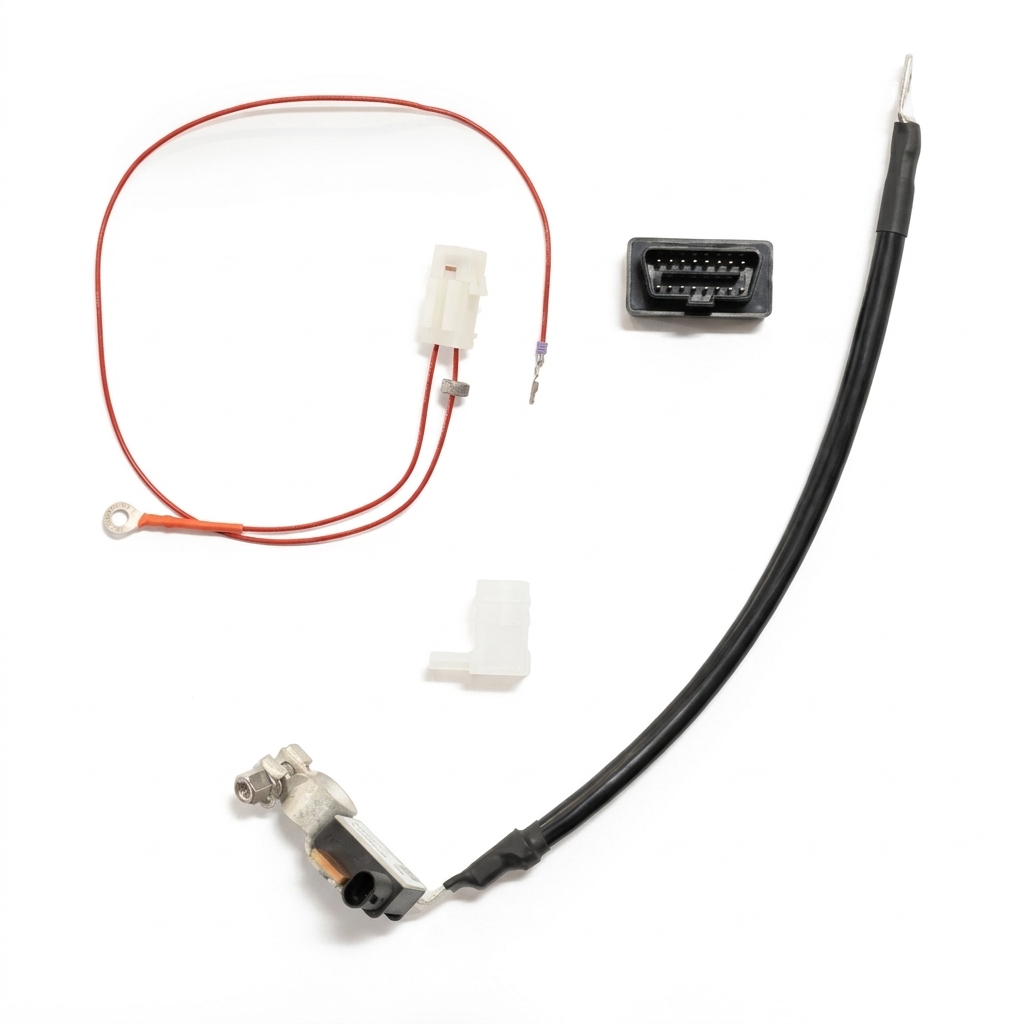



Upgrade your Porsche electrical system with the ultimate 12V Lithium to AGM Battery Conversion Kit. Designed specifically to solve factory LiFePO4 battery failure, sudden BMS sleep lockouts, and prohibitive OEM replacement costs, this solution restores dependable starting power, robust cold cranking capacity, and long-term cyclic durability.
Modern Porsche vehicles, notably the 911 (992 platform) and Cayenne (9Y0/9YA platform), were originally fitted with lightweight 12V Lithium Iron Phosphate (LiFePO4) starter batteries integrating internal Battery Management System (BMS) microcontrollers. While offering weight savings, these factory lithium units present severe drawbacks in real-world ownership: internal relay disconnects triggered by low voltage lockouts, total system bricking following minor parasitic drain, sensitivity to sub-freezing temperatures, and astronomical replacement costs. The Porsche Lithium to AGM Battery Conversion Kit is engineered by battery and automotive systems engineers to eliminate these failure modes permanently by converting the vehicle architecture to a robust, highly stable 12V Absorbent Glass Mat (AGM) power reserve.
By transitioning your Porsche to a heavy-duty 12V 92Ah AGM platform, power delivery is stabilized under all environmental extremes. AGM chemistry features micro-porous glass fiber separators saturated with ultra-pure sulfuric acid electrolyte, creating a sealed, recombinant VRLA (Valve Regulated Lead-Acid) system. This internal grid structure distributes current rapidly across thick, reinforced positive plates, minimizing internal resistance and delivering explosive cold cranking amps without electronic latch-off risks. Whether facing severe winter conditions or prolonged garage storage, AGM technology offers proven cold-weather resilience and unmatched tolerance against low-voltage discharge cycles.
Cyclic endurance is dramatically increased through heavy-duty lead-tin-calcium grid casting, which resists grid growth, plate shedding, and accelerated corrosion caused by high-rate alternator charging. The conversion kit safeguards sensitive onboard modules by smoothing voltage ripple from the 48V/12V DC-DC converters and high-output smart alternators, ensuring that critical microcontrollers, ignition coils, and dynamic chassis sensors receive clean, uninterrupted current.
| Parameter | Engineering Specification |
|---|---|
| Nominal System Voltage | 12V (6 x 2.0V cells in series) |
| Target Battery Capacity | 92Ah (Compatible with 90Ah – 95Ah AGM) |
| Cold Cranking Performance (CCA) | 850A – 920A EN / SAE |
| Case Form Factor / DIN Code | H8 / LN5 (DIN 60038 / BCI Group 49) |
| External Dimensions (L x W x H) | 353 mm x 175 mm x 190 mm (±2 mm) |
| Terminal Configuration | Standard SAE Tapered Automotive Posts (Left Negative, Right Positive) |
| Hold-Down Type | B13 Base Ledge Hold-down |
| BMS & LIN Integration | LIN-Bus Sensor Interconnect / PIWIS Coding Adapter Interface |
| Cell Chemistry | VRLA Absorbent Glass Mat (AGM) |
This conversion kit is purpose-engineered for modern Porsche platforms equipped with factory lithium starter batteries that suffer from proprietary LIN-bus communication lockouts. Direct fitment coverage includes the Porsche 911 (992 generation Carrera, S, GTS, Turbo, and GT3 models) and Porsche Cayenne / Cayenne Coupe (9Y0 / 9YA generation from 2018 onward). It is also mechanically and electronically adaptable to shared platform sister models operating the same battery monitoring architecture.
Modern Porsche vehicles utilize an intelligent alternator management system (IBS/LIN battery monitoring) paired with demanding Start-Stop functionality and recuperation brake regeneration cycles. Under standard operation, the factory lithium battery communicates state-of-charge (SoC) and temperature to the vehicle gateway module. When installing an AGM battery in place of the OEM lithium unit, the charging profile must be harmonized. This conversion kit delivers the physical mount adaptation, terminal polarity extensions, and proper hardware/coding parameters necessary to reconfigure the gateway battery chemistry setting from Lithium to AGM (Fleece), ensuring correct 14.4V to 14.8V charging maps without overvoltage, thermal runaway, or dash-cluster battery fault warnings.
Installation of the Porsche Lithium to AGM Battery Conversion Kit should be executed with precision. Prior to disconnecting the negative terminal, ensure the vehicle ignition is fully switched off and sleep mode has engaged to prevent CAN-bus network disruptions. Disconnect the LIN-bus sensor harness from the factory lithium battery terminal. Extract the depleted lithium unit and secure the heavy-duty 12V 92Ah AGM battery into the factory battery tray utilizing the standard B13 hold-down flange.
Connect the positive terminal post, torque to 5.5-6.5 Nm, and attach the negative terminal with the integrated battery sensor harness. To complete the conversion, connect a diagnostic scan tool (such as PIWIS III or an advanced bidirectional scanner supporting Porsche gateway adaptations) to the OBD-II port. Access the Gateway / Battery Sensor module, update the battery chemistry from Lithium (LiFePO4) to AGM (Fleece / AGM 92Ah), and execute a battery registration adaptation. This recalibrates the charging algorithm, preventing overcharging and guaranteeing full alternators and regenerative braking synchronization. Inspect terminals semi-annually and maintain the AGM battery with an AGM-specific maintenance charger if the vehicle is placed into seasonal hibernation.
The factory Porsche lithium battery incorporates an internal electronic relay that locks permanently open when voltage drops below a critical threshold, rendering the expensive battery unusable even if the cells are intact. Replacing it with an AGM battery provides proven reliability, immune to electronic sleep lockouts, and eliminates multi-thousand-dollar replacement costs.
No. When installed according to the included guidelines and coded via diagnostic scanner (such as PIWIS or high-end OBD-II tools) to change the battery chemistry map from Lithium to AGM, the vehicle gateway recognizes the new battery profile seamlessly, resulting in zero fault codes or warnings.
Yes. Premium 92Ah AGM batteries are designed specifically to withstand high-cycling Start-Stop loads and micro-hybrid energy recovery demands, providing identical electrical system responsiveness under everyday driving conditions.
No. Lithium-specific charging profiles feature distinct multi-stage algorithms and higher baseline cutoff voltages. Once converted to AGM, you must use a standard microprocessor-controlled 12V lead-acid/AGM smart charger or tender.
The kit is engineered to utilize the standard battery carrier anchor points already present in the Porsche chassis (such as Cayenne 9Y0 and 911 992). The battery footprint conforms to the standard H8/LN5 DIN size, fastening directly into place using the factory mounting bracket without cutting or chassis modification.
Verified technical specifications, vehicle compatibility, and maintenance answers.
Yes. This conversion kit is specifically engineered for Porsche models originally equipped with 12V LiFePO4 batteries (such as 9Y0 Cayenne, 992 911, and modern 718 variants) to transition to heavy-duty Absorbent Glass Mat (AGM) technology. It fully supports Porsche Auto Start-Stop systems and regenerative energy recuperation. However, vehicle coding via an advanced diagnostic system (such as PIWIS III) is mandatory upon installation to reconfigure the Gateway and Intelligent Battery Sensor (IBS) from Lithium to AGM chemistry, ensuring correct charging maps and state-of-charge calculation.